Reading
It usually focuses on a specific, concrete topic such as a historical event, a biographical sketch of a notable person, or a description of a natural phenomenon.
Style: Narrative or descriptive.
Focus: Identifying specific information, dates, and names.
Difficulty: Lower linguistic complexity, but requires speed to save time for later sections.
Shifts toward more abstract or technical subjects. It often explores a specific issue or research finding in greater detail, sometimes including different viewpoints or interpretations.
Style: Discursive or explanatory.
Focus: Understanding the structure of an argument and identifying the main ideas of various paragraphs.
Difficulty: Moderate; the vocabulary becomes more academic and specialized.
Often deals with a complex topic and requires a deeper level of reading comprehension to follow a sophisticated line of reasoning.
Style: Opinion-based or highly analytical.
Focus: Recognizing the writer's tone, purpose, and underlying attitudes (e.g., "Yes, No, Not Given" questions).
Difficulty: High; involves complex sentence structures and subtle nuances in language.
The Reading test lasts for 60 minutes.
You will have 40 questions spread over 3 passages.
There are 14 different types of questions you could be asked.
Passage 1
Passage 2
Passage 3
IELTS Reading Test
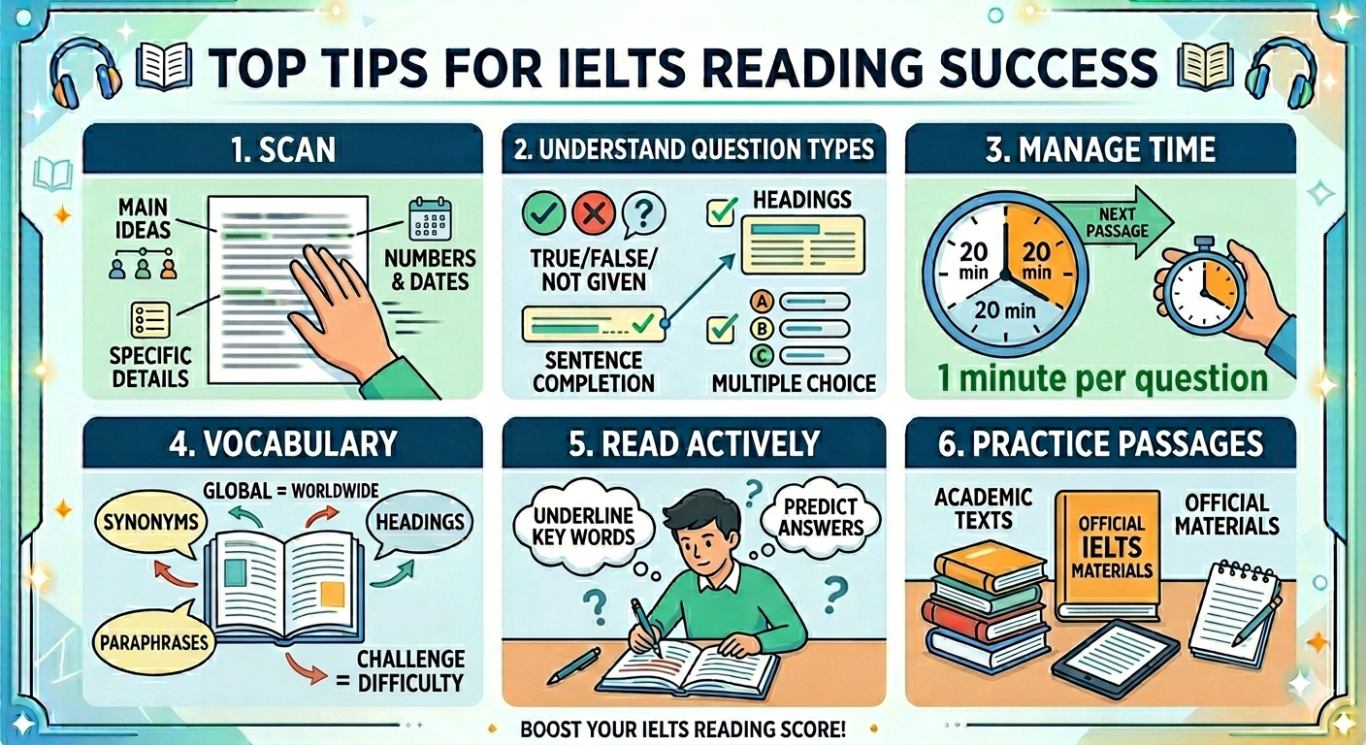
One of the most common mistakes people make is to read in IELTS Reading...
DON'T READ!
IELTS Reading is not like 'normal' reading. It is a skill to practice, and the most important skill is SCANNING.
✅Always read the questions first.
✅Identify the keywords.
✅SCAN for those words.
Those first three steps will work with almost all question types.
Join us on our YouTube channel as we explore each skill in more detail.