Process Diagram
Process Diagrams Tips & Vocabulary
Describing a process is relatively straightforward. You just have to follow the steps in order, describing each accurately with a range of appropriate and academic vocabulary.
As with Maps, you will need to use the passive voice. Recap now!
Essential Overview
To secure a top-tier band score for Task Achievement, your overview must synthesize the entire system into a single sentence. Use this formula:
Overall, the [industrial/natural] process comprises [Number] distinct stages, commencing with the [Initial Step] and culminating in the [Final Step].

Initial Signpost Language
Prior to processing, / The opening stage entails
The first step is when + clause
Production/The cycle starts/ commences/ begins when + clause

Following Steps
Subsequent to being [Verb-ed],
Following this transformation ...
At the next phase of (the process/ the cycle), + clause
Gradually, / Overtime, + clause
The process/The cycle continues/ proceeds when + clause (with + V-ing)

Final Step
The sequence culminates in / The final iteration involves...
The last/ final step is when + clause/ + V-ing
The process concludes/ finishes/ completes when + clause (with + V-ing)
Passive Voice
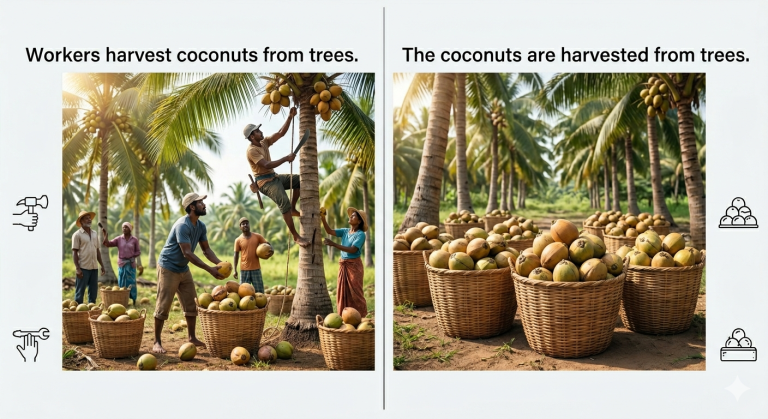
As mentioned above, you must use the passive voice to describe each stage of the process.
Why?
The focus is on the process, and no information is given about who is doing it, hence we draw attention to the objects instead.
Model Essay Example
Self-analysis tip:
Your essay should be so good that when someone else reads it, they are able to draw the graph.
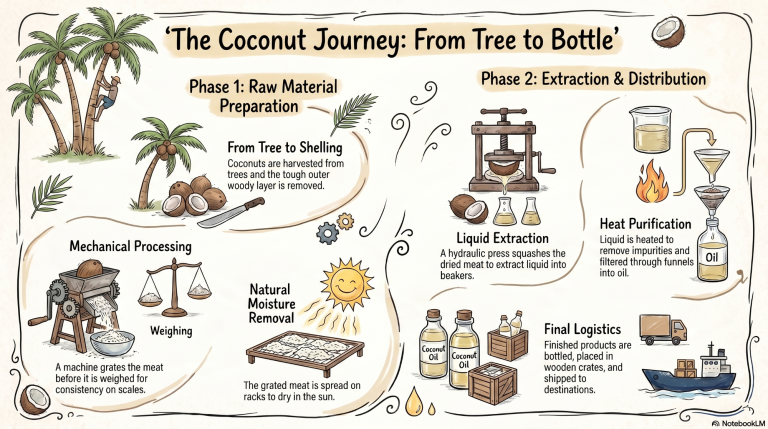
This process diagram details the multi-stage production of commercial coconut oil, tracking its progression from the initial harvest to final distribution. Overall, the process comprises two main phases: raw material preparation, followed by extraction and logistics. The journey utilizes a combination of manual, mechanical, thermal, and natural methods to transform raw fruit into bottled oil.
During Phase 1, coconuts are harvested and deshelled to remove their tough outer layer. The exposed meat undergoes mechanical processing, where it is grated and subsequently weighed on scales for consistency. Afterward, the grated meat is spread on racks to dry naturally under the sun, removing its moisture.
Phase 2 focuses on extraction and delivery. The dried meat is squashed using a hydraulic press to extract the liquid into beakers. This fluid then undergoes heat purification over a flame to eliminate impurities before being filtered through funnels into pure oil. Finally, the finished products are bottled, packed into wooden crates, and transported via trucks and cargo ships to their destinations.
Task Achievement
Zero Omissions: Every single sub-step from the diagram is clearly reported, from the initial picking of the coconuts down to the final cargo ships.
Effective Summary: The overview paragraph perfectly highlights the two-phase nature of the process and summarizes the core conversion (raw fruit to bottled oil).
Coherence & Cohesion
Logical Sequencing: The paragraphs follow the chronological order of the production line flawlessly.
Sophisticated Linkers: Time-sequential transitions ("During", "subsequently", "Afterward", "Finally") are used in sentences to manage the pacing without sounding mechanical.
Referencing: Uses accurate referencing pronouns ("this fluid", "its moisture", "their destinations") to connect steps smoothly across sentences.
Lexical Resource
Smart Paraphrasing: The text condenses complex diagram labels into high-level verbs (e.g., transforming "tough outer woody layer is removed" into "deshelled" and "spread on racks to dry in the sun" into "dry naturally").
Contextual Vocabulary: Employs precise industrial and academic collocations like "raw material preparation", "subsequent extraction", and "mechanical processing".
Grammatical Range & Accuracy
Process-Appropriate Passive Voice: The grammar shifts between present simple passive ("is grated", "is squashed", "are bottled") to describe an automated or standard industrial sequence cleanly.
Complex Clause Integration: Uses advanced syntax like participle clauses ("...naturally under the sun, removing its moisture") to efficiently combine multiple sequential actions into a single sentence.
SCORE
TA - 9
CC - 9
LR - 9
GA - 9
Overall: 9
While minor differences exist between individual examiners, this essay comfortably clears the Band 8.5 threshold due to its complete absence of grammatical errors, precise mathematical reporting, and native-like lexical control.