Speaking Part 3
Part 3: Two-way Discussion
This is a discussion with the examiner about more abstract aspects of the Part 2 topic, lasting 4-5 minutes. It involves deeper questions that require analysis and opinion.
Think Analytically
Academic Vocabulary
Actively Engage
Provide multiple reasons and examples for your opinions.
Link these together with cohesive devices.
Follow the structure:
- Idea -> Reason -> Idea -> Reason
Try to show opposing viewpoints and include examples where relevant.
Incorporate more complex words and phrases to demonstrate higher proficiency.
This is the chance to really show off!
Make sure you use all the academic structures and vocabulary that you know.
Unlike the other two parts, you should expect this section to be more like an in-depth discussion.
Ask questions or seek clarification if needed to show interaction skills. The examiner will likely enjoy this kind of rigourous conversation!
Speaking Part 3 -
Sample Questions and Model Responses
Topic 1:
The Influence of Role Models
Question 1: How do you think role models shape young people's values and aspirations?
Role models have a significant impact on the values and goals of young people by acting as real-life examples of success and strong character. In my view, when teenagers see someone who has beaten the odds through hard work and honest choices, they are much more likely to adopt those same qualities as their own. Additionally, this inspiration is even stronger when young people find role models in fields they are personally interested in, which really boosts their motivation to follow a similar path and reach their own goals.
Question 2: What qualities make someone an effective role model in today's digital age?
In today’s world, where social media magnifies everyone’s actions, a good role model needs a mix of authenticity and resilience. First of all, being genuine is vital because young people are very good at spotting when someone is being fake or just "acting" for the camera. They look for consistency between what a person says and what they actually do. Additionally, showing resilience is key; when an influencer handles a setback or a mistake with honesty instead of giving up, it teaches their followers how to build their own mental toughness.
Question 3: How has the concept of role models changed over the past few decades?
The idea of a role model has shifted quite a bit, moving away from traditional figures like politicians or teachers toward more relatable influencers. A few decades ago, people mostly looked up to those in positions of authority. However, thanks to the internet, role models now come from all walks of life, including social media and grassroots activism. While this has democratized inspiration—meaning anyone can be a leader—it also makes things more complicated because it’s much harder to verify if these people are actually providing reliable or "good" advice.
Below are sample questions and Band 8+ answers for IELTS Speaking Part 3,
with detailed explanations of why they achieve high scores.
Why this response achieves Band 8+:
It uses high-level idiomatic language, such as "beaten the odds," which demonstrates a natural command of English.
The progression from a general statement to specific makes the argument highly persuasive and easy to follow.
It uses precise collocations like "strong character" and "personal interests," allowing for an authentic conversational flow.
Why this response achieves Band 8+:
It uses natural, high-level collocations like "spotting when someone is being fake" and "mental toughness." The logic is clear, moving from the challenge of the digital age to a specific personality trait and its effect on the audience.
There are also two good instances of cohesive devices using 'additionally' and 'first of all'.
Why this response achieves Band 8+:
It successfully explains a complex "paradigm shift" using accessible language like "all walks of life." It also shows a high level of critical thinking by presenting a "double-edged sword" argument (greater accessibility vs. less accountability).
There is a clear structure by showing both sides of the argument: positive and negative.

- Authenticity /ˌɔː.θenˈtɪs.ə.ti/ - The quality of being real or true rather than a copy or fake.
- Resilience /rɪˈzɪl.jəns/ - The capacity to recover quickly from difficulties; toughness.
- Consistency /kənˈsɪs.tən.si/ - Always behaving or performing in a similar way to be reliable.
- Democratized /dɪˈmɒk.rə.taɪzd/ - Made something accessible or available to everyone.
- Authority /ɔːˈθɒr.ə.ti/ - The power or right to give orders, make decisions, and enforce obedience.
- Verify /ˈver.ɪ.faɪ/ - To make sure or demonstrate that something is true, accurate, or justified.
- Aspirations /ˌæs.pɪˈreɪ.ʃənz/ - A hope or ambition of achieving something.
- Magnifies /ˈmæɡ.nɪ.faɪz/ - Makes something appear larger or more important than it is.
Academic Vocabulary
Idiomatic & Collocation Phrases
- Beaten the odds: To succeed despite having very low chances of success or facing many obstacles.
- Follow a similar path: To do the same thing that someone else has done before you.
- All walks of life: Used to refer to people who come from many different social statuses, backgrounds, or occupations.
- Grassroots activism: Political or social movements that start from the local level (the people) rather than from leaders or the government.
Topic 2:
The Importance of Lifelong Learning
Question 1: Why do you think lifelong learning is becoming increasingly important in modern society?
Lifelong learning is more important than ever because technology is changing so fast. Since automation and AI are transforming the job market, people need to keep picking up new skills just to stay employable and adaptable. It’s not just about work, though; the sheer amount of information available today means we have to keep learning to make smart decisions in our daily lives. Ultimately, continuing to learn throughout your life keeps your mind sharp and makes life more fulfilling, rather than just being a way to get a promotion.
Question 2: How can individuals be motivated to engage in lifelong learning?
Motivating people to keep learning requires a mix of internal curiosity and external rewards. From an internal side, if we show people how interesting and relevant a subject is to the real world, they’re more likely to enjoy the process. On the other hand, things like professional certificates or workplace recognition give people a tangible reason to put in the effort. It also helps to have a supportive community or easy-to-access resources, as these things make it much easier to overcome hurdles like a busy schedule or a lack of confidence.
Question 3: What challenges do people face when trying to learn throughout their lives?
People face a few big obstacles, mainly to do with time and the feeling of being overwhelmed. Many working professionals or parents simply struggle to find a spare hour in the day to study. On top of that, because information changes so quickly nowadays, it can be discouraging to feel like your knowledge is becoming outdated. However, these issues can be managed by using micro-learning—like studying in short bursts—or finding a mentor, which helps people stay on track despite their busy lives.
Why this response achieves Band 8+:
It uses academic vocabulary like "stay employable" and "keeps your mind sharp." It correctly identifies that lifelong learning has both professional and personal benefits, which shows a mature perspective.
The response wraps up succinctly using the transition 'ultimately'.
Why this response achieves Band 8+:
The response uses a clear organizational structure (internal vs. external factors). Using phrases like "on the other hand" and "overcome hurdles" demonstrates the smooth, cohesive transitions expected at a Band 7.5 or 8.0 level.
Although the vocabulary may not be overly academic, topic-specific terms are employed effortlessly.
Why this response achieves Band 8+:
It tackles abstract problems (knowledge obsolescence) with practical solutions (micro-learning).
The vocabulary is precise but conversational, using natural-sounding terms like "in short bursts" and "outdated."

- Automation /ˌɔː.təˈmeɪ.ʃən/ - The use of machines or computers to do work that was previously done by people.
- Adaptable /əˈdæp.tə.bəl/ - Able to adjust or change to be successful in new situations.
- Incentives /ɪnˈsen.tɪvz/ - Things that encourage a person to do something or to work harder.
- Tangible /ˈtæn.dʒə.bəl/ - Real and able to be shown or touched; not imaginary.
- Hurdles /ˈhɜː.dəlz/ - Problems or difficulties that must be overcome to achieve a goal.
- Obsolescence /ˌɒb.səˈles.əns/ - The state of being no longer useful or needed because of new inventions.
- Cognitive /ˈkɒɡ.nə.tɪv/ - Relating to the mental process of knowing, learning, and understanding.
- Fulfilling /fʊlˈfɪl.ɪŋ/ - Making someone feel satisfied and happy because of fully developing their character or abilities.
Academic Vocabulary
Idiomatic & Collocation Phrases
- Keep your mind sharp: Describes maintaining high mental alertness and cognitive function as you age.
- Internal curiosity: The natural desire to learn something for its own sake, rather than for a reward.
- From all walks of life: Used to describe a group of people from many different backgrounds or social levels.
- Short bursts: A period of very intense activity for a short time (used here to describe "micro-learning").
- Stay on track: To continue doing something as planned or expected, without getting distracted.
- Becoming outdated: When information/technology is no longer useful because it has been replaced by something newer.
Topic 3:
Advertising
1. What are the different ways that advertising can influence people’s buying habits?
Advertising operates on both a conscious and subconscious level. In the modern era, targeted digital ads use algorithms to present products that align with a user's recent search history, making a purchase feel almost inevitable. Furthermore, many brands utilize celebrity endorsements or "influencers" to create an aspirational lifestyle; people don't just buy the product, they buy the perceived status associated with it. Essentially, it shifts the consumer's focus from "need" to "desire."
2. Do you think there should be stricter controls on advertising aimed at children?
Absolutely. Children lack the critical thinking skills necessary to distinguish between entertainment and a persuasive sales pitch. They are particularly vulnerable to "pester power," where bright colors and catchy jingles are used to market sugary cereals or expensive toys, placing undue pressure on parents. I believe many countries are right to implement bans on junk food advertising during peak children’s viewing hours to combat rising rates of childhood obesity.
3. Will traditional forms of advertising, like billboards and newspapers, disappear in the future?
While they certainly won't be as dominant as they once were, I doubt they will vanish entirely. Physical billboards still offer high visibility in high-traffic urban areas where digital fatigue hasn't yet set in. However, as news consumption shifts almost exclusively to mobile devices, print advertising is becoming a niche market. We are likely to see a hybrid approach where traditional spaces incorporate augmented reality or QR codes to bridge the gap between the physical and digital worlds.
Why this response achieves Band 8+:
Scores highly for lexical precision. Using terms like "subconscious level," "algorithms," and "aspirational lifestyle" demonstrates an ability to discuss psychological and technical concepts with ease.
Why this response achieves Band 8+:
This response uses strong collocations such as "critical thinking skills," "distinguish between," and "pester power."
It also provides a clear social perspective, moving the answer from personal opinion to a broader societal context.
Why this response achieves Band 8+:
High marks for cohesion and logical argumentation. The use of "while they certainly won't," "on the other hand," and "hybrid approach" shows the candidate can navigate complex, contrasting viewpoints without losing the flow of the argument.

Academic Vocabulary
- Subconscious /ˌsʌbˈkɒn.ʃəs/ - Relating to the part of the mind of which one is not fully aware but which influences one's actions.
- Algorithms /ˈæl.ɡə.rɪ.ðəmz/ - Sets of rules or processes followed by a computer to solve problems or make decisions.
- Inevitably /ɪˈnev.ɪ.tə.bli/ - In a way that cannot be avoided or prevented.
- Persuasive /pəˈsweɪ.sɪv/ - Good at making someone do or believe something through reasoning or temptation.
- Obesity /əʊˈbiː.sə.ti/ - The state of being grossly fat or overweight, typically to an unhealthy degree.
- Visibility /ˌvɪz.əˈbɪl.ə.ti/ - The degree to which something has attracted general attention; prominence.
- Exclusively /ɪkˈskluː.sɪv.li/ - Only restricted to a specific person, group, or area.
- Incorporate /ɪnˈkɔː.pər.eɪt/ - To include something as part of a whole.
Idiomatic & Collocation Phrases
- Targeted digital ads: Advertisements that are shown to specific people based on their data and online behavior.
- Aspirational lifestyle: A way of living that people want to achieve, often associated with wealth or success.
- Perceived status: The level of importance or social standing that people think a person has based on what they own.
- Distinguish between: The ability to see or understand the difference between two things.
- Pester power: The ability of children to nag their parents into buying items they have seen advertised.
- Digital fatigue: A state of exhaustion or boredom caused by spending too much time looking at screens and digital content.
- Niche market: A small, specialized area of the market for a particular product or service.
- Bridge the gap: To connect two different things or to reduce the difference between them.
Topic 4:
Work-Life Balance
1. What are the most effective ways for individuals to maintain a healthy work-life balance?
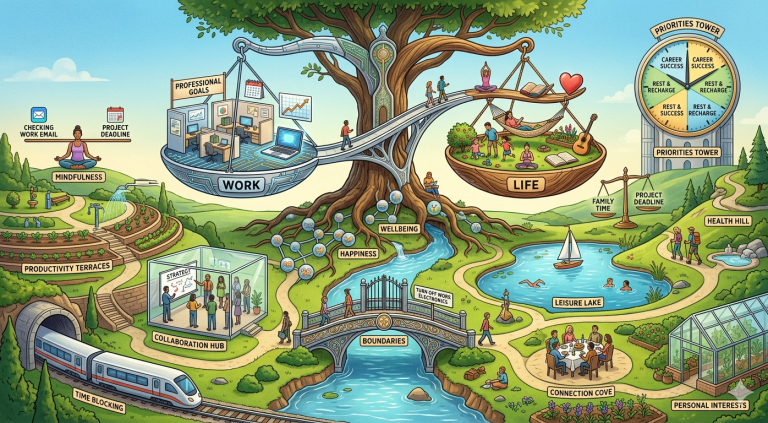
The most successful strategy is the establishment of rigid boundaries between one's professional and personal spheres. For instance, many people now utilize "time-blocking," where specific hours are strictly reserved for exercise or family, treating these appointments with the same level of importance as a board meeting. Additionally, psychological detachment—the ability to mentally "switch off" from work-related problems once the clock strikes five—is crucial. Without these intentional habits, the stress of the workplace tends to bleed into one's private life, leading to chronic exhaustion.
2. Is it the responsibility of the employer or the employee to ensure a good work-life balance?
I would argue it’s a shared responsibility, though the onus often lies with the employer to set the organizational tone. A company should implement policies—such as "right to disconnect" protocols—that discourage after-hours communication. However, the employee must also exercise self-discipline. If an individual does not set personal boundaries or learn to delegate tasks effectively, even the most supportive corporate culture will not prevent them from experiencing burnout.
3. Do you think people will have more leisure time in the future because of automation?
There is a long-standing theory that Artificial Intelligence and automation will handle the menial, repetitive tasks, freeing us up for creative pursuits. While this sounds idealistic, history suggests that when technology increases efficiency, the "saved" time is often filled with higher production targets rather than rest. Unless there is a fundamental shift in our economic systems, such as a universal move toward a four-day work week, I suspect we will remain just as busy as we are today.
Why this response achieves Band 8+:
This response focuses on topic-specific vocabulary depth. Instead of just saying "stay busy," it uses professional terminology like "time-blocking" and "psychological detachment." This shows the examiner you have the vocabulary to discuss specific mental health and productivity strategies.
Why this response achieves Band 8+:
Scores well for grammatical complexity. It uses a "balanced argument" structure (onus on employer vs. self-discipline of employee) and employs the second conditional ("If an individual does not... even the most supportive culture will not...") to discuss hypothetical outcomes.
Why this response achieves Band 8+:
Rather than just agreeing that robots will give us more free time, it offers an interesting perspective by using high-level phrasing like "fundamental shift" and "idealistic."
Answering in this way opens up the possibility of an in-depth discussion with the examiner - who will no doubt love that opportunity!
Academic Vocabulary
- Rigid /ˈrɪdʒ.ɪd/ - Stiff or fixed; not able to be changed or adapted.
- Detachment /dɪˈtætʃ.mənt/ - The state of being objective or aloof; emotionally or mentally separating oneself.
- Chronic /ˈkrɒn.ɪk/ - Persisting for a long time or constantly recurring (usually referring to an illness or habit).
- Onus /ˈəʊ.nəs/ - Used to refer to something that is one's duty or responsibility.
- Protocols /ˈprəʊ.tə.kɒlz/ - The official procedure or system of rules governing affairs of state or occasions.
- Menial /ˈmiː.ni.əl/ - (Of work) not requiring much skill and lacking prestige.
- Idealistic /ˌaɪ.dɪəˈlɪs.tɪk/ - Characterized by the pursuit of perfection or high principles, often in an unrealistic way.
- Fundamental /ˌfʌn.dəˈmen.təl/ - Forming a necessary base or core; of central importance.
Idiomatic & Collocation Phrases
- Professional and personal spheres: The two main areas of a person's life (work and home).
- Mentally "switch off": To stop thinking about work or problems so that you can relax.
- Bleed into: When one part of your life starts to negatively affect or overlap with another.
- Set the organizational tone: When leaders establish the culture, values, and expectations of a company.
- Right to disconnect: The legal or policy-based right for employees to ignore work emails/calls outside of work hours.
- Experiencing burnout: A state of emotional, physical, and mental exhaustion caused by excessive and prolonged stress.