Two Questions
Two-Part Question Advice
This essay type presents a statement followed by two distinct questions that you must address.
Unlike standard Problem-and-Solution essays, these questions can combine entirely different prompts—such as asking for a cause and an opinion, or a definition and an evaluation.
- You must dedicate precisely one body paragraph to answering the first question and the second body paragraph to the second question. This fits perfectly with our 4-paragraph structure used previously!
- Each question naturally commands its own focused, fully extended body paragraph.
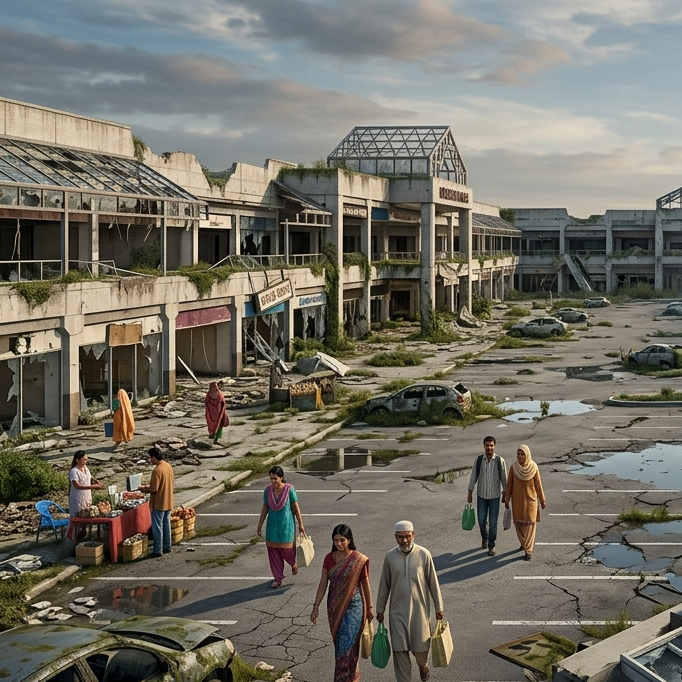

In many parts of the world, traditional shopping malls are experiencing a steady decline as online retail platforms continue to grow.
1. Why is online shopping becoming more popular than physical retail stores?
2. Do you think this trend is a positive or a negative development for local communities?
In contemporary society, individuals are increasingly choosing to marry and have children much later in life compared to previous generations.
1. What are the main reasons for this shift in family planning?
2. What impacts does this trend have on society as a whole?
Here are some example prompts...

Many universities now require students to complete a period of unpaid work experience or an internship as part of their degree program.
1. Is this a fair requirement to place on university students?
2. How does practical experience benefit a graduate's future employment prospects?
International tourism has become a major industry, leading to widespread exposure to different foreign cultures.
1. To what extent does tourism help to reduce cultural prejudice?
2. What can local governments do to ensure that incoming tourism does not damage indigenous cultures?
In summary, two-part question essay types have the most straightforward structure to them, hence your TA and CC score should be high.
To really achieve those high scores, use a fantastic variety of vocabulary and complex grammar structures.
International tourism has become a major industry, leading to widespread exposure to different foreign cultures.
To what extent does tourism help to reduce cultural prejudice?
What can local governments do to ensure that incoming tourism does not damage indigenous cultures?
The expansion of international tourism has significantly heightened global exposure to diverse foreign cultures. While global travel serves as a powerful mechanism for reducing cultural prejudice, local governments must implement targeted zoning laws and cultural heritage regulations to protect indigenous traditions from commercial degradation.
Firstly, cross-border travel fosters intercultural empathy by directly challenging deep-seated stereotypes through personal interaction. When travelers engage firsthand with foreign communities, they frequently discover shared human values that contradict preconceived media biases or cultural assumptions. For the purpose of illustration, data from international tourism boards reveals that travelers returning from regions often misrepresented in global media express significantly higher levels of tolerance and cultural appreciation toward those populations. It follows that immersive tourism acts as a vital tool for reducing global prejudice and cultivating international solidarity.
Likewise, municipalities must enact proactive strategies to safeguard domestic heritage sites from the pressures of mass commercialization. Unregulated tourism frequently leads to the commodification of sacred rituals and the environmental destruction of historic landmarks, stripping indigenous communities of their authentic cultural identity. As a case in point, several heritage destinations have successfully mitigated these risks by enforcing strict visitor caps and mandating that tourism revenue directly fund local cultural preservation initiatives. In this way, strategic legislative intervention ensures that global interest protects, rather than exploits, vulnerable indigenous practices.
In conclusion, international tourism is highly effective at reducing cultural prejudice, yet it necessitates robust municipal regulations to shield indigenous populations from exploitation. Without a concerted global effort to balance commercial travel with structural heritage protections, future generations risk losing irreplaceable cultural diversity to the forces of global tourism.
Word Count: 277
Band Score: 9
Modern economic and cultural shifts have fundamentally altered traditional timelines for marriage and family expansion. While prolonged educational paths and escalating living costs primarily drive this delay in family planning, the resulting demographic shift significantly impacts society by straining public welfare systems and reshaping workforce dynamics.
Principal among the causes is that the rising demand for higher qualifications paired with severe economic pressures forces young adults to prioritize financial stability over early domesticity. In the modern knowledge economy, securing a stable career often requires advanced degrees and years of entry-level labor, leaving little room for the financial commitments of child-rearing. Specifically, global economic indicators reveal that the soaring cost of urban housing and student debt has doubled the time it takes for young professionals to achieve financial independence compared to their parents' generation. Accordingly, delaying marriage is not a rejection of family values, but a calculated response to modern financial realities.
With respect to the broader consequences, this widespread postponement of child-rearing triggers profound demographic imbalances that fundamentally challenge the structure of modern communities. As birth rates plummet due to delayed childbearing, nations face an inverted population pyramid characterized by a shrinking workforce and a rapidly aging citizenry. For instance, several developed economies are currently experiencing acute labor shortages alongside a diminishing tax base, which directly threatens the sustainability of national healthcare and pension frameworks. Inevitably, a seemingly personal choice regarding family timing aggregates into a macro-economic crisis that alters the future viability of public infrastructure.
In conclusion, the trend toward later family planning stems directly from extended career preparation and financial hurdles, yet it ultimately imposes severe structural and demographic pressures on the wider community. Without comprehensive state interventions to ease the economic burdens on young families, future societies face the unavoidable reality of stagnant economic growth and overburdened social security frameworks.
Word Count: 284
Band Score: 9
Task Achievement
Extended arguments:
Rather than listing multiple reasons or solutions, each paragraph takes a single claim and systematically builds it out. The ideas move logically from initial premise to real-world illustration, followed by a clear concluding statement of impact.
Exact introduction:
Sentence 1 paraphrases the prompt's premise regarding tourism's growth, and Sentence 2 provides a clear, dual-pronged overview that answers both questions directly.
Coherence and Cohesion
Advanced transitions:
The essay maps out a sophisticated internal progression using precise academic transitions which are not hackneyed.
Structural Balance:
Every sentence in the body paragraphs adheres strictly to the TEEL framework (Topic sentence, Explanation, Example, Link), ensuring that information flows predictably and clearly without any confusing deviations.
Lexical Resource
Advanced vocabulary:
The vocabulary choices are highly advanced with high-level collocations specific to the topic, such as dismantling cultural prejudice, cross-border travel, commercial degradation, preconceived media biases, and homogenizing forces.
Variation:
To avoid repetitive phrasing, the essay substitutes key concepts throughout the text—altering tourism to global travel, cross-border travel, mass commercialization, and commercial travel.
Grammar
Complex structures:
The essay features varied complex structures, such as adjective clauses ("...regions often misrepresented in global media..."), noun clauses ("...mandating that tourism revenue directly fund..."), and adverbial clauses of concession ("While global travel serves as...").
Task Achievement
Linear Argument:
The essay strictly addresses both parts of the prompt in isolation. Body Paragraph 1 identifies the precise causes (economic burdens and career timelines), while Body Paragraph 2 details the exact consequences.
Fully Extended Thesis:
Rather than presenting a laundry list of multiple reasons or impacts, each body paragraph isolates one comprehensive idea and expands it through an explanation, a concrete example, and a logical conclusion.
Coherence and Cohesion
Direct Signposting:
By utilizing straightforward academic markers, the progression of the argument is instantly clear to the examiner.
Structural Balance:
Every sentence in the body paragraphs adheres strictly to the TEEL framework (Topic sentence, Explanation, Example, Link), ensuring that information flows predictably and clearly without any confusing deviations.
Lexical Resource
Advanced vocabulary:
The vocabulary choices are precise and appropriate for a high-level discussion. Terms like prolonged educational paths, knowledge economy, inverted population pyramid, diminishing tax base, and macro-economic crisis are used accurately.
Collocational Accuracy:
Words are paired correctly (e.g., escalating living costs, financial commitments, acute labor shortages), resulting in demonstrating high proficiency of using English.
Grammar
Subordinate Clauses:
The writing displays a wide range of complex structures, including causal clauses ("As birth rates plummet due to delayed childbearing..."), relative clauses ("...which directly threatens the sustainability..."), and concession clauses ("While prolonged educational paths... drive this delay...").
Sentence Variety:
This essay constantly shifts the grammatical subject and structural opening to keep the writing dynamic and not formulaic.
Important to note!
The examiner does not care what you really think.
It is a test of your English ability only.
Hence, although you need good ideas, the task is assessing your writing only.
In contemporary society, individuals are increasingly choosing to marry and have children much later in life compared to previous generations.
What are the main reasons for this shift in family planning?
What impacts does this trend have on society as a whole?